06 Juil Our ambitions for 2030
To better assess and monitor ocean health and to expand the systematic, long-term sampling of marine microbiomes, the French Navy, Sorbonne University, and the Plankton Planet initiative have joined forces to launch the Mission Bougainville.
Since 2023—and at least through 2030—several French Navy vessels operating in the Indian and Pacific Oceans have embarked four to six students each year from the Sorbonne University Alliance, serving under the newly created status of Biodiversity Midshipman Volunteers (VOABio).
Under the scientific leadership of the mission (Sorbonne University, CNRS, and the University of Maine), the VOABio officers collect planktonic microbiome samples along the routes followed by naval vessels. Every year, each ship samples approximately one hundred stations, collecting three samples at each station for genetic and morphological analyses in regions that are rarely visited by oceanographic research vessels. Using simple, field-deployable, yet scientifically robust instruments, these samples are subsequently analysed through quantitative imaging and genomics.
The mission brings together sailors, researchers, students, and civil society organizations. Beyond pioneering new approaches to frugal oceanography, Mission Bougainville will generate a unique dataset spanning unprecedented spatial, temporal, and ecological scales across the world’s largest ocean basin—the Indo-Pacific.
MISSION BOUGAINVILLE: TOWARDS CONSISTENT AND SYSTEMATIC MONITORING OF OCEAN SURFACE MICROBIODIVERSITY
Ocean health, which fundamentally depends on biodiversity, has never been monitored consistently and systematically at the global spatio-temporal scale (Lombard et al., 2019). We still face a vast gap in globally coherent biological observations, representing one of the most significant knowledge deficits in Earth system science. Yet standardized, continuous biodiversity observations are indispensable for understanding and modelling the ecology and evolution of marine life, from which emerge the global biogeochemical cycles that sustain Earth’s habitability.
This need has become even more urgent in the context of rapid ocean changes driven by warming, acidification, deoxygenation, and shifts in global circulation. Recent developments—including the launch of Bio-GO-SHIP (Clayton et al., 2022) and emerging citizen-oceanography initiatives (e.g., de Vargas et al., 2022)—have demonstrated considerable potential to address this critical observational gap if adopted at the international scale.
Mission Bougainville, an unprecedented partnership between Sorbonne University, the French Navy, and Plankton Planet, addresses this challenge by leveraging the continuous presence of naval vessels operating in vast oceanic regions that are rarely visited by scientific research ships.
MISSION BOUGAINVILLE: THE OCEAN MICROBIOME AS AN EARLY AND SENSITIVE INDICATOR OF OCEAN HEALTH
The primary scientific objective of Mission Bougainville is the study of the marine microbiome, which accounts for more than two-thirds of ocean biomass and encompasses the vast majority of marine biodiversity, yet remains largely unexplored.
Each litre of seawater contains between 10 and 100 billion viruses, bacteria, protists, and other microscopic organisms spanning the entire Tree of Life. Collectively known as the ocean microbiome, these organisms—although invisible to the naked eye (typically <1 mm)—perform several essential functions, including:
- regulating global biogeochemical cycles (oxygen, carbon, nutrients, and other elemental cycles);
- sustaining marine food webs that ultimately support millions of species, including humankind;
- regulating Earth’s climate through the biological carbon pump and the production of volatile metabolites that influence atmospheric composition.
Exceptionally diverse both taxonomically and functionally, the ocean microbiome is among the most sensitive biological indicators—and indeed drivers—of environmental change. It responds rapidly to both local and global disturbances, including pollution and climate change. Monitoring its composition and functioning therefore provides an efficient means of detecting ecological imbalance at an early stage. Continuous observation of the ocean microbiome offers unique insights into marine biodiversity and the processes underpinning ecosystem health, thereby informing conservation strategies and environmental policy.
However, studying these « invisible forests » remains constrained by the lack of reliable, affordable instruments suitable for large-scale deployment in remote marine environments.
Conventional instruments used to investigate planktonic microbiomes are often sophisticated, expensive, and difficult to deploy aboard non-specialized vessels or in remote marine environments. Developing scientifically robust, cost-effective, and easy-to-use technologies is therefore essential to enable continuous, large-scale monitoring of ocean biodiversity.
To address this challenge, the Plankton Planet initiative has developed a suite of affordable instruments and standardized protocols for measuring:
- biodiversity through genetic analyses (de Vargas et al., 2022) and quantitative imaging (Pollina et al., 2022; Mériguet et al., 2022);
- environmental parameters, including photosynthetically active radiation (PAR), conductivity, temperature, and pressure (CTD);
- contextual remote-sensing observations, particularly ocean-colour data.
These technologies have been designed according to three fundamental principles:
- Accessibility – affordable enough to enable deployment at planetary scale, particularly in countries of the Global South;
- Flexibility – lightweight, user-friendly, and adaptable for operation aboard a wide variety of vessels, including sailing boats, fishing vessels, cargo ships, and naval ships;
- Scientific reliability – capable of producing observations that meet the highest international scientific standards, with fully characterized uncertainties.
The validation of these frugal instruments and protocols will ultimately enable local stakeholders—including universities, citizen scientists, public authorities, and non-governmental organizations—to participate actively in standardized monitoring of aquatic microbiome biodiversity within their own environmental contexts. In doing so, they will contribute directly to global ocean observation while strengthening local scientific capacity.
Mission Bougainville has also established a partnership with the University of Maine (USA) to enhance the biological and temporal resolution of satellite observations, particularly those acquired by NASA’s PACE mission (Plankton, Aerosol, Cloud, ocean Ecosystem).
By increasing the frequency and accuracy of satellite observations and systematically comparing them with in situ biodiversity measurements, the project will provide a far more comprehensive understanding of marine ecosystem dynamics across both short and long temporal scales.
MISSION BOUGAINVILLE: OPEN GLOBAL DATA TO ADVANCE OCEAN SCIENCE
To achieve these objectives, Sorbonne University and the French Navy have established the logistical and administrative framework enabling Master’s students from the Sorbonne University Alliance to serve overseas for one-year deployments as Biodiversity Midshipman Volunteers (VOABio).
The VOABio position was created specifically by the French Navy to support Mission Bougainville. By design, the role combines scientific research at sea and ashore with full operational service as a commissioned naval officer trainee.
Mission Bougainville forms part of the broader Plankton Planet initiative, whose ambition is to transform our understanding of the invisible life inhabiting the world’s oceans, particularly in regions where biological observations remain scarce. The project addresses the urgent need to develop biodiversity monitoring capacities across all spatial, temporal, and biological scales while remaining compatible with the financial, technological, and legal constraints that currently limit global ocean observation.
Between 2026 and 2030, within France’s Indian and Pacific Ocean maritime territories, Mission Bougainville will collect approximately:
- 1,200 sampling stations;
- 2,500 plankton biomass samples for DNA sequencing;
- 1,200 imaging samples, representing approximately 2 million plankton images;
- 1,200 environmental CTD profiles;
- approximately one million measurements of Photosynthetically Active Radiation (PAR).
All raw observations and associated datasets will undergo rigorous quality control before being deposited in internationally recognized open-access repositories, including the European Nucleotide Archive (ENA) for genetic data and EcoTaxa for imaging datasets, ensuring unrestricted access for the global scientific community.
The data will subsequently be processed, taxonomically annotated, and published as standardized abundance tables together with their associated metadata and environmental context through Zenodo Data Papers, thereby facilitating large-scale reuse by researchers, environmental agencies, and decision-makers who may not possess specialized bioinformatics expertise.
By the completion of the project, Mission Bougainville will have generated an unprecedented multi-year dataset designed to deepen our understanding of the structure, ecology, and evolution of the ocean microbiome.
This unique resource will enable major advances in the study of:
- the adaptation of ocean microbiomes to climate change, by identifying microbial community responses to environmental change;
- the eco-evolutionary dynamics of plankton across spatial and temporal scales that remain largely unexplored, providing a comprehensive picture of microbial diversity throughout the Indo-Pacific—the world’s largest ocean basin;
- the structure and ecology of microbial interactomes, namely the complex interaction networks linking microbial taxa, and their integration into existing biogeochemical models.
Furthermore, by making both tools and datasets openly available to the international scientific community, Mission Bougainville will stimulate research across numerous disciplines, including:
- interactions between microbial communities and other marine organisms, particularly protected species;
- harmful algal blooms and the biological mechanisms underlying their emergence and development;
- broader ecosystem processes, including the influence of microbiomes on marine food webs and large-scale ocean biogeochemistry.
Through these contributions, the project will substantially improve our understanding of the global ocean and support more effective conservation strategies and sustainable management of marine ecosystems.
Mission Bougainville also promotes a sustainable and environmentally responsible approach to ocean research.
The French Oceanographic Fleet has committed to reducing its carbon footprint by 40% by 2030. While dedicated oceanographic cruises remain indispensable for many scientific objectives, they inevitably generate significant CO₂ emissions. Mission Bougainville offers a complementary approach by taking advantage of French Navy vessels that are already deployed worldwide to conduct sovereign maritime missions.
By collecting ocean microbiome observations from these operational platforms, the mission produces regular, standardized, and globally distributed datasets with virtually no additional carbon footprint. Rather than commissioning dedicated research cruises, the project capitalizes on vessels already at sea, thereby substantially reducing both the environmental and economic costs of planetary-scale ocean observation.
These « ships of opportunity » enable the systematic collection of biological and environmental samples throughout the year, dramatically increasing the temporal continuity and geographical coverage of ocean observations.
By relying on French Navy support and assistance vessels operating throughout the Indian and Pacific Oceans, Mission Bougainville aims to increase by an order of magnitude the number of sampling stations collected during landmark expeditions such as Tara Oceans (2009–2013) over a comparable five-year period.
In doing so, Mission Bougainville will deliver an unprecedented global ocean biodiversity dataset while maintaining one of the lowest carbon footprints ever achieved for a programme of this scale.
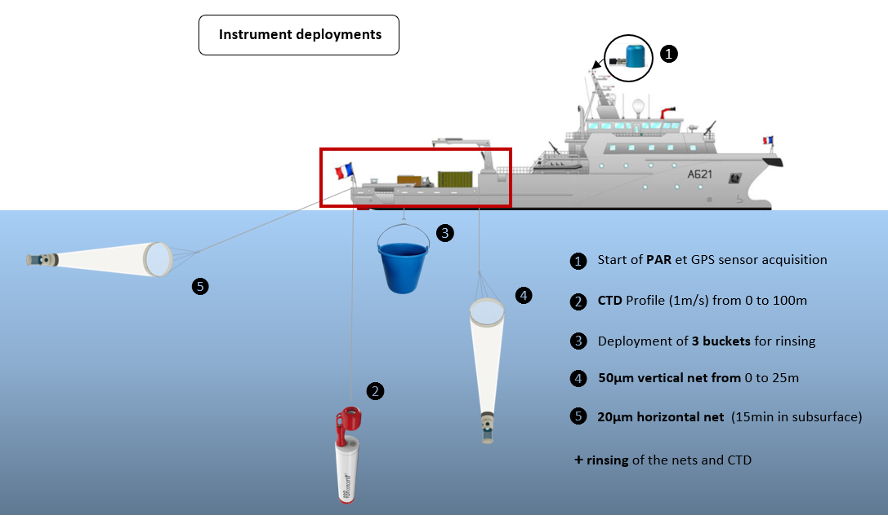
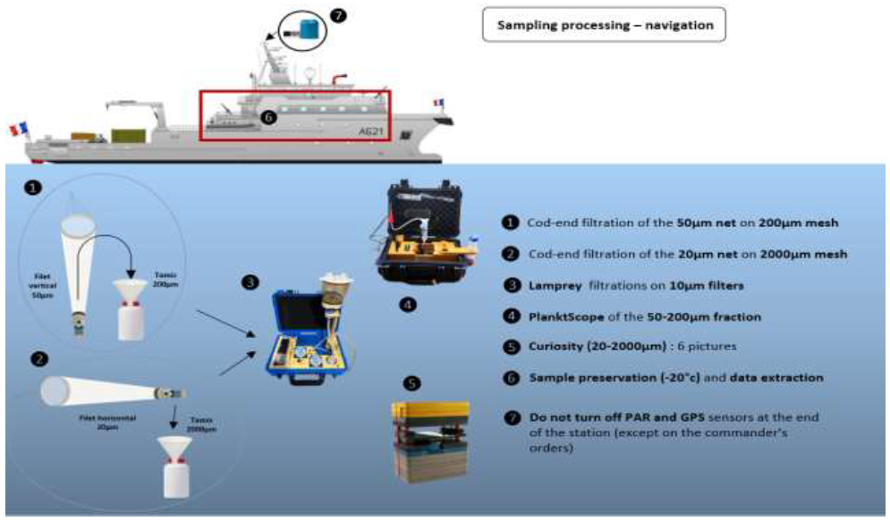
Mission Bougainville at a Glance
Mission Bougainville is founded on four complementary ambitions:
- Advance ocean science by generating long-term, standardized observations of the ocean microbiome across some of the world’s least explored marine regions.
- Develop frugal oceanography by validating affordable, scientifically robust technologies capable of supporting large-scale global biodiversity monitoring.
- Train the next generation by providing students with a unique interdisciplinary experience combining scientific research, operational deployment, and public service.
Protect the ocean by delivering open-access data that will strengthen research, environmental management, and evidence-based public policy while minimizing the carbon footprint of ocean observation.
HOST INSTITUTION
Sorbonne University
Mission Bougainville is a French scientific initiative led by Sorbonne University in partnership with the French Navy and the Plankton Planet initiative. The French National Centre for Scientific Research (CNRS) and the University of Maine (USA) are also core scientific partners.
In parallel, partnerships have been established with research institutions in La Réunion, as well as with local authorities and communities, to support innovative approaches to monitoring ocean health across the western Indian Ocean. Mission Bougainville aims to consolidate and expand these collaborations over the coming years.
As part of its outreach activities, the project has also initiated partnerships with local stakeholders to raise public awareness—including among school communities—of the extraordinary diversity and ecological importance of the « invisible life » that inhabits the Indian Ocean.
Sorbonne University is France’s leading marine university and one of Europe’s foremost centres for marine research. It hosts the country’s largest academic marine science community, bringing together approximately 1,500 researchers, engineers, and technical staff. Through the Sorbonne University Alliance, it also integrates the scientific expertise of the French National Museum of Natural History (Muséum national d’Histoire naturelle).
Mission Bougainville is hosted and coordinated by the Institute of the Ocean (iOcean). Sorbonne University supports the mission through four complementary pillars:
Strategic Alignment
Mission Bougainville fully supports the University’s strategic priorities in ocean sustainability and climate resilience. It contributes to the institution’s broader commitment to advancing knowledge of marine biodiversity while providing scientific evidence to inform conservation policies and sustainable ocean governance.
Research Infrastructure
The project benefits from access to Sorbonne University’s internationally recognized marine research stations, including:
- Roscoff Biological Station for environmental genomics;
- Villefranche Oceanographic Laboratory for quantitative plankton imaging;
- Banyuls-sur-Mer Oceanological Observatory for scientific outreach and public engagement.
Additional laboratories are expected to join the project, including BOREA (Biology of Aquatic Organisms and Ecosystems), which will contribute expertise in biodiversity modelling and ecological forecasting.
Interdisciplinary Scientific Expertise
Mission Bougainville integrates expertise across marine biology, environmental genomics, quantitative imaging, satellite remote sensing, ocean optics, and ecosystem modelling.
This interdisciplinary framework is strengthened through collaborations with the CNRS, Plankton Planet, the University of Maine, and the GO-SEE Research Federation (Global Ocean Systems Ecology and Evolution), which brings together researchers from CNRS, Sorbonne University, Université PSL, the CEA, and the European Molecular Biology Laboratory (EMBL).
Education and Human Capacity Building
Sorbonne University coordinates the recruitment, scientific training, and academic supervision of the Biodiversity Midshipman Volunteers (VOABio)—Master’s students deployed aboard French Navy overseas support vessels.
By combining scientific excellence with operational field experience, Mission Bougainville provides a unique interdisciplinary training programme that prepares the next generation of marine scientists while contributing directly to global ocean observation.
PROJECT TEAM :
Mission Bougainville brings together an interdisciplinary team of marine biologists, oceanographers, genomicists, remote-sensing specialists, engineers, and naval officers from leading French and international institutions.
| Name | Institution | Role within Mission Bougainville |
| Christophe Prazuck | Institute of the Ocean (Sorbonne University) | Operational Director |
| Colomban de Vargas | CNRS – Roscoff Biological Station | Scientific Director – Marine Biodiversity & Environmental Genomics |
| Fabien Lombard | Sorbonne University – Villefranche Oceanographic Laboratory | Quantitative Imaging and Marine Ecology |
| Emmanuel Boss | University of Maine | Ocean Optics, Biophysics and Satellite Observation |
| Guillaume Bourdin | University of Maine | Satellite Oceanography and Remote Sensing |
| Morgane Guillam | Sorbonne University – Roscoff Biological Station | VOABio Programme Coordination, Technical Support, Sampling Protocols and Training |
| Adélaïde Perruchon | Sorbonne University – Villefranche Oceanographic Laboratory | Quantitative Imaging Protocols and Instrumentation |
| Erwan Legeay | Sorbonne University – Roscoff Biological Station | Environmental Genomics Protocols and Instrumentation |
| Damien Guiffant | Sorbonne University – Roscoff Biological Station | Logistics and Field Operations |
| Nicolas Henry | CNRS – Roscoff Biological Station | Bioinformatics and Biostatistics |
| Éric Goberville | Sorbonne University – BOREA Laboratory | Biodiversity Modelling and Data Analysis |
| François Lallier | Sorbonne University – Institute of the Ocean & Roscoff Biological Station | VOABio Recruitment, Outreach and Public Engagement |
| Marie-Line Sauvée | Sorbonne University – Institute of the Ocean | Administration, Financial Management, Communication and VOABio Recruitment |
| Six Biodiversity Midshipman Volunteers (VOABio) each year | French Navy (one-year appointments in La Réunion, New Caledonia and French Polynesia) | Field Sampling, On-board Analyses, Scientific Outreach and Community Engagement |
The VOABio Programme
Each year, six Master’s students from the Sorbonne University Alliance are recruited as Biodiversity Midshipman Volunteers (VOABio) and embark aboard French Navy support vessels operating in the Indian and Pacific Oceans.
This unique programme combines scientific research, operational service, and science outreach. During their one-year deployment, VOABio officers collect microbiome samples, implement standardized observation protocols, engage with local scientific partners, and conduct educational activities in schools, universities, and host communities encountered during port calls.
As commissioned officer cadets, they serve as both researchers and ambassadors for marine biodiversity, creating a unique bridge between science, society, and the French Navy.
Mission Bougainville
│
── Operational Director
│ Christophe Prazuck
│
── Scientific Director
│ Colomban de Vargas
│
── Scientific Coordination
│ • Genomics
│ • Quantitative Imaging
│ • Satellite Observation
│ • Ecological Modeling
│
── Technical Coordination
│ • Sampling protocols
│ • Logistics
│ • Bioinformatics
│
└── VOABio Programme
Six students deployed annually
OPEN SCIENCE, CAPACITY BUILDING AND PUBLIC ENGAGEMENT
Mission Bougainville embraces the principles of Open Science, ensuring that the knowledge, data, technologies, and expertise generated by the project become lasting resources for the international scientific community, public institutions, educators, and society at large.
Beyond producing scientific knowledge, the project seeks to strengthen global capacity for ocean observation by fostering collaboration among researchers, students, public authorities, naval personnel, and citizens. Through open data, education, technology transfer, and international partnerships, Mission Bougainville aims to maximize both scientific excellence and societal impact.
Open Science and FAIR Data
Mission Bougainville is committed to making all scientific outputs openly accessible in accordance with the FAIR principles—Findable, Accessible, Interoperable and Reusable.
Following rigorous quality control, all observations collected during the mission will be deposited in internationally recognised repositories that ensure their long-term preservation, interoperability and unrestricted accessibility.
These include:
- European Nucleotide Archive (ENA) for environmental DNA (metabarcoding) datasets;
- EcoTaxa, the international reference platform for quantitative plankton imaging;
- Zenodo, where curated datasets, abundance tables, metadata and associated documentation will be published as citable Data Papers.
The project will therefore deliver not only scientific publications but also a permanent digital infrastructure supporting future research on marine biodiversity and ocean health.
Technology Transfer and Capacity Building
Mission Bougainville goes beyond data generation by promoting the widespread adoption of frugal oceanographytechnologies.
The validation of robust, affordable and easy-to-use instruments will enable universities, research institutes, environmental agencies, NGOs and citizen-science initiatives around the world to implement scientifically standardised biodiversity monitoring programmes.
Particular attention is given to expanding access to ocean observation technologies in Small Island Developing States (SIDS) and countries of the Global South, where conventional oceanographic infrastructures often remain financially inaccessible.
By lowering technological and economic barriers, Mission Bougainville contributes to the democratization of marine biodiversity observation at the global scale.
Education and Human Capacity Development
Training the next generation of ocean scientists is one of the project’s central ambitions.
Each year, Master’s students from the Sorbonne University Alliance are selected to serve as Biodiversity Midshipman Volunteers (VOABio) aboard French Navy vessels.
This unique programme combines:
- advanced scientific training;
- operational experience at sea;
- interdisciplinary teamwork;
- international cooperation;
- science communication and public engagement.
By 2030, approximately forty young scientists will have completed this programme, forming an international network of professionals with first-hand experience in large-scale ocean observation and marine biodiversity research.
Science Communication and Ocean Literacy
Mission Bougainville places science communication at the heart of its activities.
Throughout their deployments, VOABio officers organise educational events aboard naval vessels and during port calls, engaging with:
- schools;
- universities;
- local communities;
- environmental organisations;
- public authorities;
- naval personnel.
These activities highlight the extraordinary diversity and ecological importance of the ocean microbiome while promoting a broader understanding of the role of marine biodiversity in climate regulation, ecosystem functioning and human well-being.
By making the « invisible life » of the oceans visible to society, Mission Bougainville contributes directly to the objectives of the UN Ocean Decade and the global development of Ocean Literacy.
Mission Bougainville also serves as a platform for international scientific cooperation.
During overseas deployments, project scientists and VOABio officers develop partnerships with universities, research institutes, governmental agencies, NGOs and local communities throughout the Indo-Pacific region.
Annual scientific workshops organised in participating territories strengthen regional collaboration through:
- joint scientific meetings;
- technical training sessions;
- exchanges with environmental authorities;
- public conferences;
- collaborative research initiatives.
These activities reinforce France’s contribution to international ocean science while supporting regional capacity-building and long-term scientific partnerships.
Mission Bougainville therefore represents not only a scientific programme, but also an instrument of science diplomacy, promoting dialogue, cooperation and shared stewardship of the global ocean.
Legacy
Mission Bougainville is designed to leave a lasting legacy that extends well beyond the duration of the project.
Its legacy will include:
- an unprecedented open-access database documenting the biodiversity of the ocean microbiome;
- validated technologies enabling affordable global biodiversity monitoring;
- a new generation of scientists trained in interdisciplinary ocean observation;
- strengthened international scientific partnerships across the Indo-Pacific;
- increased public awareness of the essential role played by marine microorganisms in sustaining Earth’s climate and marine ecosystems.
Together, these outcomes will contribute to a more comprehensive, coordinated and sustainable global ocean observing system.
Sorry, the comment form is closed at this time.