12 Nov Planetary biology: putting cells at the heart of our understanding of Earth
Interview with Colomban de Vargas, CNRS research director, corresponding author of the article published this month in Cell on the biology of planetary microbial systems, and scientific director of Mission Bougainville.
In Cell, you argue for a “planetary biology”. What does that mean?
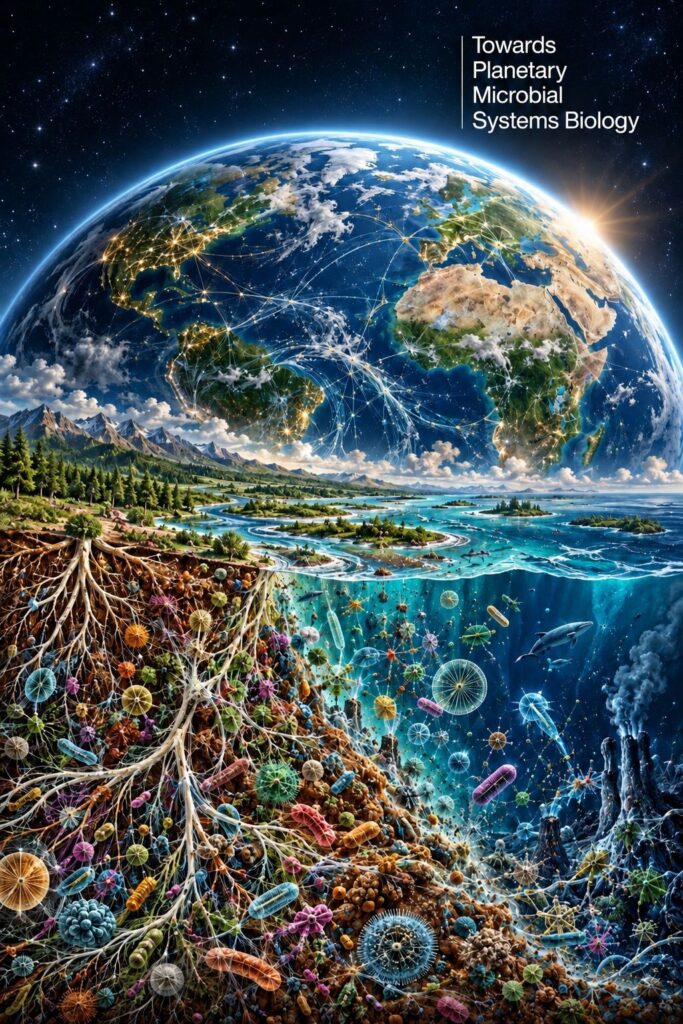
It is a biology of microbial systems at the scale of the planet. We start from a simple idea: Earth’s microbiomes are not separate worlds. They form a continuum linking the oceans, sediments, soils, atmosphere and host organisms. Interactions among microorganisms, and with their environment, generate major ecosystem functions that regulate the biosphere. The units of analysis of planetary biology are therefore molecules and cells. The goal is twofold: to understand the mechanisms of ecology and evolution at this scale, and to predict how these systems will respond to environmental change, whether natural or linked to our activities. This requires a change of perspective, because the concepts of ecology and biology were built mostly from visible, multicellular organisms, essentially animals and land plants, which appeared only relatively recently on the timescale of the evolution of life.
What tools support this ambition?
First, molecular and cellular approaches combined with environmental multi-omics, which make it possible to measure DNA, RNA, proteins and small molecules, as well as cellular structures, directly in ecosystems. Then artificial intelligence and modelling, which are needed to move from billions of heterogeneous data points to predictions. But none of this can be done without fieldwork and experimentation: mobile laboratories to bring cutting-edge technologies as close as possible to life in situ, ecotrons where temperature, humidity or atmospheric composition can be controlled, and federated networks to harmonise protocols. And above all, open and standardised data, shared worldwide. The TREC initiative and the Tara Europa expedition are pioneers in this respect: 115 transects explored between land and sea, more than 90 institutions from 30 countries involved, and more than 70,000 samples collected following 200 standardised protocols.
What obstacles hold planetary biology back?
Fragmentation, in all its forms: conceptual, scientific, technological, logistical and political. Disciplines rarely speak the same language, biology protocols differ from one laboratory to another, and access to environments remains difficult, mainly for geopolitical reasons. There is also a lack of resources: such an approach requires long-term, open and equitable programmes and funding. A single laboratory or a three-year project is not enough to observe and model a living planet!
How does Mission Bougainville fit into this approach?
It is a concrete and highly original application of it. Launched in Roscoff in September 2023, Mission Bougainville engages and connects existing communities, students and researchers from academia (Sorbonne University and CNRS) and sailors of the French Navy, around biological protocols that are relatively easy to deploy in the field and that make it possible to measure the cellular biodiversity of aquatic microbiomes. This breaking down of silos not only merges scientific and maritime knowledge for optimal fieldwork, but also overcomes several axes of logistical, geopolitical and financial fragmentation, creating a frugal, potentially long-lasting infrastructure for planetary ocean biology with a very low carbon footprint.
The new status of “Volunteer Biodiversity Officer Cadets” created by the Navy for Mission Bougainville, and the 11 million km² of France’s planetary ocean domain, are decisive ingredients of this unique “macroscope”. Of course, cultural obstacles between the academic and military worlds had to be overcome during the pilot phase of the mission (2023–2025), but they were largely overcome by the thirst for exploration and the curiosity that sailors and researchers share, as well as by the beauty of ocean microbiomes and the sense of a collective commitment to new, universal knowledge. By 2030, we should have explored more than 1,500 sites, and therefore states of the planktonic microbiome, across the spatial, temporal and environmental dimensions of the Indian and Pacific Oceans. This is an unprecedented dataset for understanding how microorganisms self-organise, adapt and evolve in response to currents, island effects and seamounts, natural climate phenomena such as El Niño, but also local pollution and climate changes linked to human activities, such as marine heatwaves.
Sorry, the comment form is closed at this time.