07 Juil The Bougainville Mission, the Molecular Clock, and JEDI: First Scientific Results
Nearly three years ago, we embarked for a year aboard vessels of the French Navy to take part in the launch of this mission. The objective of this first year was to investigate the still poorly explored planktonic ecosystems of the southwestern Indian Ocean. From the coast of Kenya to the French Southern and Antarctic Lands, via Madagascar, we sampled a wide range of environments, from coastal waters to the open ocean.
Now PhD students, we continue our research on plankton. Manon focuses on planktonic symbioses, relying in particular on the genomic data collected since the beginning of the Bougainville Mission.
In this article, we first explain the value of metabarcoding approaches for studying plankton diversity before presenting the first scientific descriptions derived from the data collected during the Bougainville Mission.
DNA and the Molecular Clock
In the early 1950s, James Watson and Francis Crick described the three-dimensional double-helix structure of DNA, building in particular on the pioneering work of Rosalind Franklin. This landmark discovery opened the way to studying life at an entirely new scale and paved the path for decades of continuous advances in molecular biology.
In 1977, Carl Woese discovered that part of the genome functions as a « molecular clock. » Present in all organisms within a major lineage (for example, bacteria) and evolving relatively slowly, this gene preserves the evolutionary history of species. This discovery enabled Woese to reveal the existence of a third major domain of life: the Archaea. Until then, biologists had assumed that all life on Earth belonged to one of two great lineages: the eukaryotes (which include animals, plants, fungi, and certain unicellular organisms such as Paramecium) and the prokaryotes (which were thought to include all other microscopic organisms). Woese demonstrated that life is in fact divided into three major evolutionary lineages.
The concept of the molecular clock is fundamental. By comparing the sequences of this gene among organisms, scientists can reconstruct their evolutionary relationships and position them on the tree of life. This discovery laid one of the foundations of modern microbiology.
Metabarcoding and Plankton Diversity
These DNA fragments can also be used to identify the organisms from which they originate. They are known as molecular barcodes. By extracting DNA directly from the environment, targeting these short sequences, and comparing them with reference databases, researchers can obtain a snapshot of the biological diversity present in a sample.
This approach is known as metabarcoding. The prefix meta- is added to barcoding (the identification of species using a standardized short DNA sequence) because the technique is applied not to a single organism, but to a mixture of organisms—or more precisely, to environmental DNA (eDNA) contained within a sample. In the case of the Bougainville Mission, this environmental DNA comes from filtered seawater.
The use of molecular barcodes has profoundly transformed our understanding of the microbial world. Fewer than 1% of microorganisms can be cultured in the laboratory, meaning that direct analysis of environmental DNA has made it possible to access an immense reservoir of previously invisible biodiversity. In the marine environment, the Tara Oceans expedition revealed that approximately 30% of the observed eukaryotic diversity could not be assigned to any known organism. In other words, a substantial fraction of marine biodiversity remains undiscovered. Programmes such as the Bougainville Mission are therefore essential to improve our understanding of this still largely unexplored diversity.
JEDI: A Universal Barcode for the Tree of Life
Metabarcoding nevertheless faces several technical challenges, many of which are linked to the choice of molecular barcode. The number of copies of the target gene in each cell, the length of the DNA fragment analysed, and the marker’s ability to discriminate among closely related species all strongly influence the results obtained.
Over the past several years, a number of reference barcodes have been developed. Each offers specific advantages, but until recently none was capable of spanning the full diversity of life, from bacteria to animals. Consequently, different molecular markers have generally been required for different taxonomic groups.
Recent work has led to the development of the JEDI barcode (Joint cellular life-Encompassing DIversity), designed to characterize biodiversity across the entire tree of life. This is the marker used in the Bougainville Mission to explore the full spectrum of biological diversity contained in the collected samples.
References
de Vargas, C., Audic, S., Henry, N., Decelle, J., Mahé, F., Logares, R., Lara, E., Berney, C., Le Bescot, N., Probert, I., Carmichael, M., Poulain, J., Romac, S., Colin, S., Aury, J.-M., Bittner, L., Chaffron, S., Dunthorn, M., Engelen, S., … Karsenti, E. (2015). Eukaryotic plankton diversity in the sunlit ocean. Science, 348(6237), 1261605.
Priest, T., Henry, N., Weber, T., Planat, L., Rousseau, C., Dittami, S. M., Yeh, Y.-C., Needham, D. M., Ruscheweyh, H.-J., Rigaut-Jalabert, F., Simon, N., Romac, S., Gall, F. L., Beavis, T., Moog, K., Moussy, A., Silva, C. D., Belser, C., Team, E., … de Vargas, C. (2025). The JEDI marker as a universal measure of planetary biodiversity. Preprint.
Woese, C. R., & Fox, G. E. (1977). Phylogenetic structure of the prokaryotic domain: The primary kingdoms. Proceedings of the National Academy of Sciences of the United States of America, 74(11), 5088–5090.
The Bougainville Mission: The First Metabarcoding Analyses
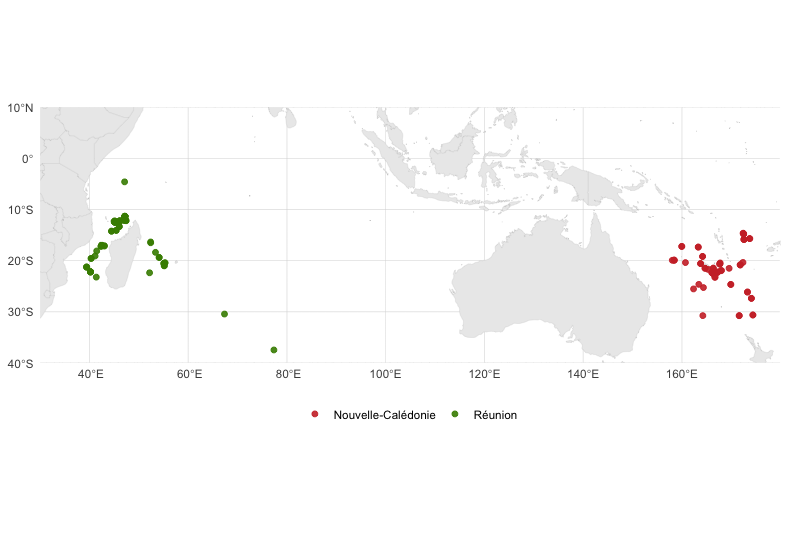
During the first cohort of Volontaires Officiers Aspirants (VOAs), 231 environmental DNA samples (Figure 1) were collected and filtered into two size fractions: >20 µm and >50 µm. The samples were sequenced using the universal JEDI marker (V4–V5 rDNA), enabling the characterization of all three domains of life—Bacteria, Archaea, and Eukaryota—as well as eukaryotic chloroplasts, the organelles responsible for capturing the light energy required for photosynthesis.
Structure of the identified communities
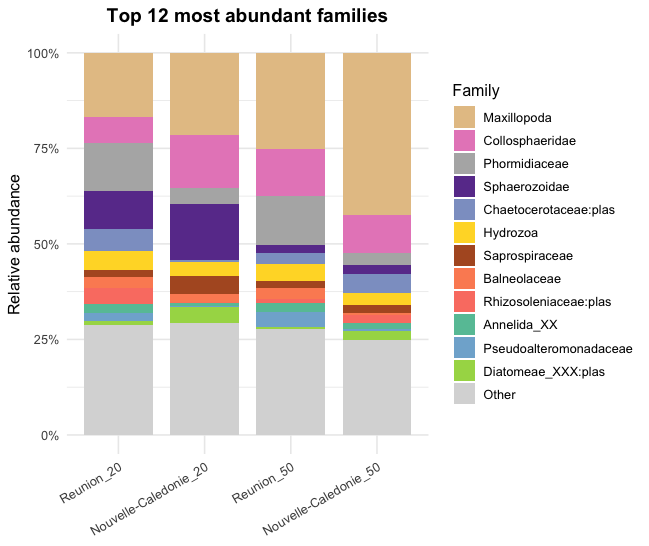
The analyses reveal that the communities are dominated by the following taxonomic groups (Figure 2):
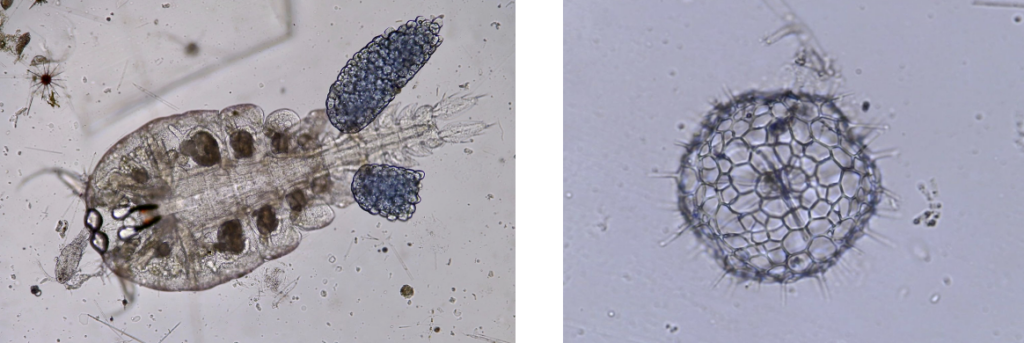
- Zooplankton is largely dominated by Maxillopoda (primarily copepods), Hydrozoa, and the colonial radiolarian families Collosphaeridae and Sphaerozoidae (Figure 3).
- Phytoplankton is chiefly represented by diatoms, with a particularly strong presence of the families Chaetocerotaceae and Rhizosoleniaceae.
- Bacteria are represented mainly by Phormidiaceae (photosynthetic cyanobacteria), Balneolaceae, and Pseudoalteromonadaceae (heterotrophic bacteria).
Sampling Robustness
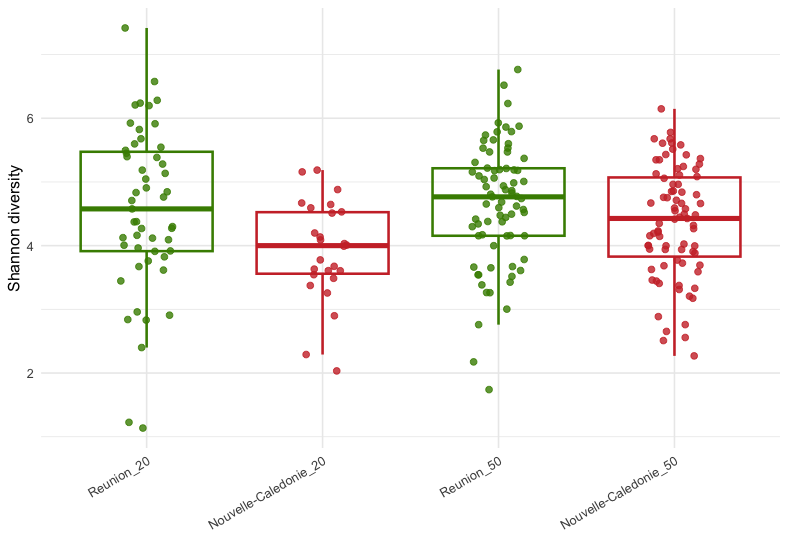
To quantify biodiversity across our study areas, we used the Shannon diversity index, which accounts for both species richness (the number of different species present) and species evenness (their relative abundances). A low Shannon index indicates a community dominated by only a few species, whereas a high index reflects a community composed of many species distributed more evenly. This analysis reveals substantial variation in species diversity among the sampling stations, highlighting the marked heterogeneity of the observed communities (Figure 4).
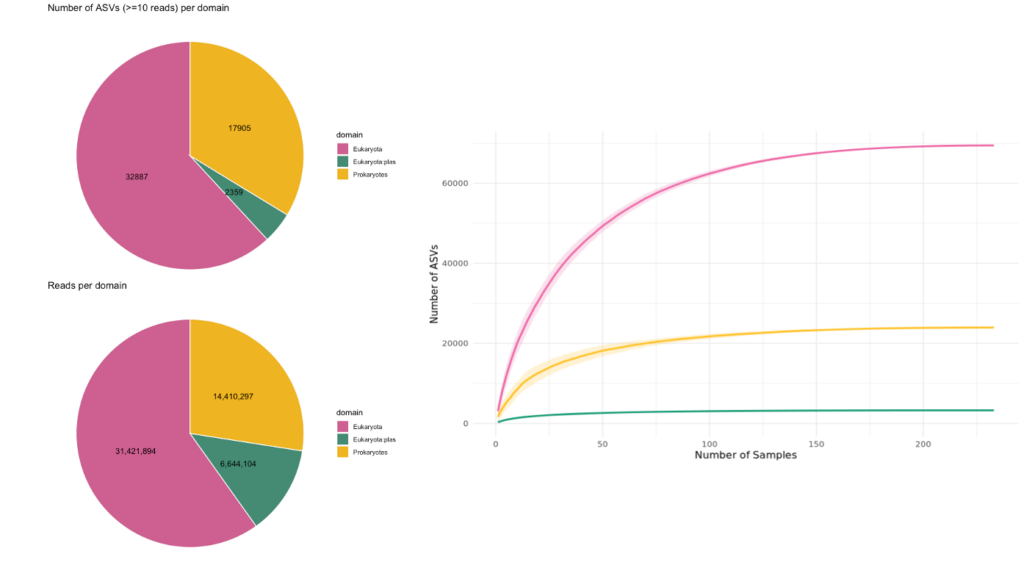
Finally, rarefaction curves based on the cumulative number of Amplicon Sequence Variants (ASVs)—each representing a unique DNA sequence—detected with each additional sample reached a plateau for all three domains of life. This result indicates that sequencing depth was sufficient and confirms the robustness of the sampling strategy, demonstrating that it successfully captured the vast majority of the biodiversity present in the sampled communities (Figure 5).
Conclusion :
These first promising results confirm the scientific value of the Bougainville Mission. From a methodological perspective, the plateau reached by the rarefaction curves indicates that the sampling strategy, combined with the selected molecular approaches, enables a comprehensive characterization of planktonic diversity in the study area. The variations in species diversity observed among sites reflect the wide range of environments covered, from coastal and island ecosystems to the open ocean.
Beyond these initial findings, the Bougainville Mission stands out for its unique character. By leveraging the operational capabilities of the French Navy, it enables repeated sampling of vast and poorly studied regions, providing a spatial and temporal coverage that is unparalleled. Despite major advances in satellite-based ocean observation, satellites only provide a view of the ocean surface and cannot reveal the taxonomic and functional richness of planktonic communities. Only direct observations, combined with molecular tools such as JEDI, can uncover this diversity and track its evolution over time.
The continuation of this mission over the coming years therefore represents a highly valuable scientific resource. The accumulation of long-term time series will make it possible to establish robust indicators of the natural variability of planktonic communities, across seasonal cycles and along gradients ranging from coastal to open-ocean environments. In the long term, these observations will contribute to advancing our understanding of plankton ecology in subtropical ecosystems and to documenting the impacts of climate change on planktonic communities.
Manon Thueux and Thomas Finet
Sorry, the comment form is closed at this time.