
06 Juil Who was Bougainville?
Who was Bougainville ?
Olivier Chaline & Christophe Prazuck
Sorbonne Université / Institut de l’océan
A PARISIAN WHO BECAME A SAILOR
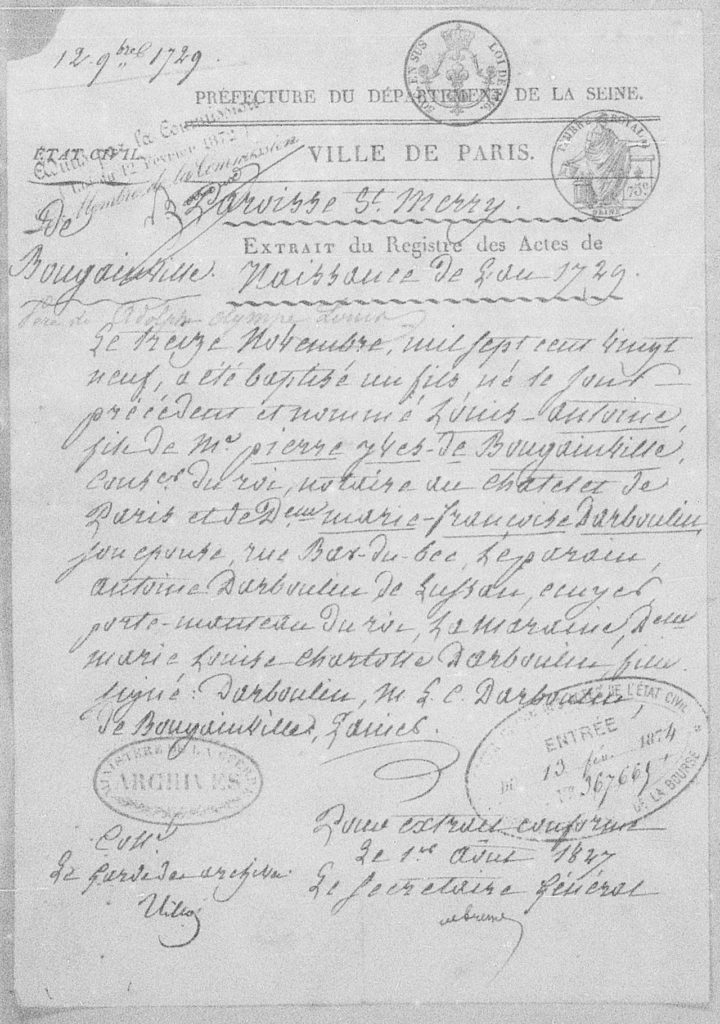
Nothing in Louis-Antoine de Bougainville’s family background or place of birth suggested he would become a sailor. He was born on November 12, 1729, in Paris, on the site of the Rue du Temple in the parish of Saint-Merry, not far from Les Halles. His family had moved to Paris from Picardy, and his father was a notary. The Bougainvilles’ social success had elevated his father to the position of alderman of Paris—that is, a member of the city council—transforming him from a bourgeois into a gentleman, as he was ennobled in 1741. As the son of a nobleman with influential connections, Louis-Antoine was steered toward the king’s court and a military career. He joined the Black Musketeers in 1750, though at the same time he received a sufficiently advanced education in mathematics to enable him to publish, four years later, a *Treatise on Integral Calculus*, which drew the attention of the scholarly world and earned him admission in 1756 to the Royal Society of London, the British equivalent of the Academy of Sciences. It was in England that he first set eyes on the sea, initially by taking a boat across the English Channel to London, where, uncertain of his future, he briefly served as secretary to the French ambassador. It was also an opportunity to meet a maritime celebrity, Admiral George Anson, who had just completed a circumnavigation of the globe from 1740 to 1744—the first by an Englishman since Francis Drake in the 16th century. The account of his voyage had been published in 1749. Certain names stuck in the young Frenchman’s memory, notably that of a desolate archipelago in the South Atlantic—the Falklands—islands on the route to the Pacific.
But Bougainville was in London at a time when the two countries were on the brink of war over North America, where English colonists and French Canadians were already clashing in the Ohio Valley. Upon his return to Paris, he became a captain of dragoons and was appointed aide-de-camp to the general designated to command in Canada, the Marquis de Montcalm. For the first time in his life, he crossed the Atlantic, from Brest to Quebec City, in the spring of 1756. From that moment on, driven by curiosity, he decided to keep a journal of his campaign. Over the course of three years, he crossed the Atlantic four times. The first time, it was the commander of the Licorne, the Chevalier de La Rigaudière, who kindly served as his instructor. When he returned in the fall of 1758, having been sent to Versailles, he put what he had learned to good use by keeping a proper navigation log. He set out again for Quebec in the spring of 1759 and, having been promoted to colonel, arrived in time for the new campaign, which turned out very badly for the French. Montcalm engaged in battle outside Quebec without waiting for reinforcements, notably Bougainville’s troops. The general was defeated and killed. Quebec surrendered. Bougainville was among the last French forces to hold out in 1760, and since he spoke English, he was tasked with delivering the general surrender of Canada. He crossed the Atlantic as a prisoner of war, having been forced to pledge not to serve against England until the end of hostilities.

Although the adventure ended on a bitter note, it nevertheless allowed him to discover—in addition to military operations—nature, the ocean, the Canadian winter, the vastness of the continent, and the Indigenous peoples; the Iroquois even naturalized him by giving him a name in their language—another world that fascinated him. What to do now? He proposed to the Secretary of State for the Navy, the Duke of Choiseul, that the French establish a settlement in the Falkland Islands, which he believed offered a good starting point for advancing into the Pacific. Choiseul, who was seeking to compensate for the territories lost in North America by acquiring new ones, gave his approval, without concern for the Spanish. He had Bougainville temporarily appointed captain of a ship, in addition to his rank of colonel. Once peace had been restored, the new sailor set sail from Saint-Malo for that distant archipelago in 1764, and again in 1765. This time, he was in command. He was no longer a passenger. In the second year, he set out to explore the Strait of Magellan. But once again, the mission came to an abrupt end. Since the Spanish allies did not take kindly to the French settling in the Falklands, Versailles decided to abandon the venture. Bougainville was sent first to negotiate in Madrid—without success—and then to evacuate the small colony, largely composed of Acadians (from a coastal region southwest of the Gulf of St. Lawrence) who had been forced into exile since the “Great Upheaval” imposed on them by the British in 1755. But this would kill two birds with one stone: the dismal voyage was to be part of a scientific expedition to the Pacific, perhaps intended to make people forget the diplomatic failure.
A SCIENTIST WHO NEVER SAILED ALONE
Bitter though its outcome had been, the adventure had opened Bougainville’s eyes not only to military operations but also to the natural world: the ocean, the Canadian winter, the vastness of the North American continent, and its Indigenous peoples. The Iroquois even adopted him symbolically, giving him a name in their own language. It was an entirely new world, one that deeply fascinated him.
What should he do next? He proposed to the Secretary of State for the Navy, the Duke of Choiseul, that France establish a settlement in the Falkland Islands, which he believed would provide an excellent staging point for reaching the Pacific. Choiseul, eager to offset the loss of France’s North American possessions by acquiring new territories, approved the plan, paying little heed to Spain’s likely objections. Bougainville was temporarily promoted to the rank of capitaine de vaisseau(post-captain), in addition to retaining his rank of colonel.
With peace restored, the newly minted naval officer sailed from Saint-Malo for the distant archipelago in 1764, returning again in 1765. This time, he was in command. He was no longer a passenger. During the second expedition, he also reconnoitred the Strait of Magellan. Yet once again the enterprise came to an abrupt end. Spain, although France’s ally, strongly objected to the French settlement in the Falkland Islands, and Versailles ultimately decided to abandon the colony.
Bougainville was first dispatched to Madrid in an unsuccessful attempt to negotiate a settlement with the Spanish authorities. He was then instructed to oversee the evacuation of the small colony, whose inhabitants were largely Acadians—French settlers from the coastal region southwest of the Gulf of St. Lawrence—who had been condemned to years of wandering since the Grand Dérangement, the mass deportation imposed upon them by the British in 1755.
Yet the government sought to turn misfortune into opportunity. The melancholy mission of relinquishing the Falkland settlement would be incorporated into a scientific expedition to the Pacific—perhaps with the additional aim of diverting attention from France’s diplomatic setback.

Both improvisation and experience were reflected in the choice of the expedition’s two ships: La Boudeuse, a brand-new frigate, and L’Étoile, a fluyt that had already sailed to the Falkland Islands. The former, built for speed and carrying a large crew, seemed at first glance an appropriate choice. Frigates were commonly used for reconnaissance missions and were increasingly deployed to support France’s overseas colonies. Yet this was no voyage to the Caribbean. The expedition would be far longer, and the frigate lacked the storage capacity to carry several months’ worth of food and fresh water. She therefore required a consort.
That role fell to L’Étoile, a cargo vessel purchased by the French Navy and converted into a troop transport. If the choice of ships reflected a measure of improvisation, the men Bougainville commanded embodied experience. His company brought together seasoned sailors and scientists. Many of the sailors had already served under him, either in Canada or in the Falkland Islands. Men from Saint-Malo formed the backbone of both the officer corps and the crews. La Boudeuse‘s second-in-command, Duclos-Guyot, sailed with his two sons. Another native of Saint-Malo, Chenard de La Giraudais, commanded L’Étoile. The senior officers also included experienced naval officers from the King’s Navy, demonstrating that the service possessed no shortage of scientific competence as well as seafaring expertise.
They were a remarkably diverse group. What did they have in common? Caro of Lorient, second-in-command of L’Étoile, was a devout Breton already familiar with the China Sea. The Gascon surgeon Vivez, likewise, stood far removed from the Parisian intellectual circles so dear to Bougainville. Then there was Prince Charles of Nassau-Siegen, a cavalry captain renowned in Paris more for his extravagant lifestyle and mounting debts than for his abilities. During the voyage, however, he revealed unexpected diplomatic skills and a keen intelligence that a life of privilege had long concealed.
Even more unusual were the scientists aboard L’Étoile. Foremost among them was the physician and botanist Philibert Commerson, whose insatiable curiosity extended to botany, zoology, and mineralogy. Brilliant though he was, his work was sometimes disorganized, and he possessed a notoriously difficult temperament. Yet he insisted on bringing along his inseparable valet, Baré, who was eventually revealed to be Jeanne Baré, his close companion. She became the first woman known to have sailed aboard a vessel of the French Navy—an achievement later acknowledged by the Crown through the award of a pension—and the first woman to complete a scientific circumnavigation of the globe.
The expedition’s second pilot and astronomer, Pierre-Antoine Véron, was as discreet as he was accomplished. Much of his work focused on determining longitude by the method of lunar distances. Although Bougainville’s official instructions made no explicit mention of this objective, solving the problem of longitude was one of the great navigational challenges of the eighteenth century.
Finally, while at the Falkland Islands, the expedition took on board a young army officer serving as an engineer, Charles Routier de Romainville, who quickly demonstrated exceptional talent as a cartographer. His contribution would prove invaluable in advancing European knowledge of one of the world’s most remote and least understood oceans: the Pacific.
THE FRENCH PACIFIC EXPLORER
Bougainville’s voyage lasted from November 15, 1766—the date of his departure from Mindin—to March 16, 1769, the day he arrived in Saint-Malo, spanning just over two years. However, a full year was taken up by the handover of the Falkland Islands to Spain. During a stopover in Brazil, Commerson discovered a flower he would later name the « bougainvillea. » It was not until November 15, 1767, that the *Boudeuse* and the *Étoile* were able to set sail for the Strait of Magellan.
The expedition moved away from the Spanish South American coast, reached the « Dangerous Islands » (the southern Tuamotus), arrived off Tahiti in early April 1768—staying there for just over a week—and continued on to the « Petites Cyclades » archipelago (Samoa), Fiji, the « Grandes Cyclades » (Vanuatu), New Holland (which he sensed was significant—this is present-day Australia), and the Solomon Islands. Finally, he stopped in the Moluccas—where finding fresh provisions had become urgent—and then in Batavia, the main settlement of the Dutch East India Company. The return journey took them through the Sunda Strait, followed by stops at Île de France (modern-day Mauritius), the Cape of Good Hope, and Ascension Island.


What place does Bougainville hold in the history of Pacific voyages of exploration? Before him, there had been other circumnavigations: Magellan, Quiros, Drake, and Le Maire. In June 1767, Samuel Wallis discovered Tahiti. Above all, in late August 1768, Captain Cook began the first of his three Pacific voyages, and no one traversed that ocean as extensively as he did.
What was the outcome of this voyage? It appears paradoxical in many respects. When measured against the instructions given to Bougainville—who had himself helped draft them—the achievements were limited and disappointing. Few unknown lands were discovered, and even Tahiti had been visited a few months earlier by Wallis. The question of the southern continent remained far from settled. Bougainville did not reach China—far from it—and even the scientific results remained modest. Time for geographical and hydrographic observations was always in short supply due to a lack of provisions; the ships selected for the expedition could not carry enough to ensure peace of mind on that score. There was no time to linger—and thus, often, no time to go ashore or even conduct methodical soundings. The complete lack of prior French experience with such voyages took its toll. All the time spent executing the handover of the Falkland Islands weighed heavily on the remainder of the journey. The desire to avoid Spanish ports and shipping lanes in the Pacific prompted them to steer away from the South American coast as soon as possible. Consequently, the ocean crossing became a gamble regarding food supplies and crew health—a risky wager, but one that was ultimately won.
Bougainville was a lucky sailor, and that luck was bolstered by the competence of his crew. He did not face the kind of crew hostility that Cook would sometimes encounter. He managed to maintain his hold over his men, even when living conditions on board deteriorated due to a lack of fresh provisions—or indeed, any provisions at all. The death toll was very low, which in itself is a success.
The true significance of this voyage lies beyond its official objectives. The method for determining longitude via lunar distances was refined by Véron during the expedition, though some of the resulting data was lost. After disembarking on Île de France, both Véron and Commerson died there without ever returning to France. While the fruits of the botanist-physician’s ambitious yet disorganized work—along with the specimens collected at various ports of call—did reach the *Jardin du Roi* (now the National Museum of Natural History), they were never fully utilized.
Yet, the voyage’s impact was immense. Coming shortly after a war lost to the British monarchy—particularly at sea—Bougainville’s expedition demonstrated that France, too, was capable of circumnavigating the globe. He returned with a young Tahitian named Aoutourou (subsequently known as Louis), who displayed a remarkable ability to adapt to Parisian social circles. Above all, Bougainville drew upon his journal to produce a book—*Voyage autour du monde* (Voyage Around the World)—published in 1771 and again in 1772, which left a lasting mark on the era. Although subsequent scientific journals and mariners paid it little heed, the general public was captivated by the navigator’s writing, particularly his description of Tahiti as « New Cythera. » Bougainville’s account resonated deeply with the dreams and fantasies of many of his contemporaries. To them, the « natural man »—or « noble savage »—represented an innocent ideal far superior to a civilization they viewed as depraved. Bougainville’s own journal reveals that he had been dazzled by his brief discovery of Tahiti, believing he had found the long-lost Golden Age. However, during the return voyage, Aoutourou’s explanations tempered his initial enthusiasm, effectively making him a precursor to the field of ethnology. Yet, readers often took away only what they wanted to hear. In the hands of Diderot—one of the *philosophes* who wrote a *Supplement to Bougainville’s Voyage* but took care not to publish it—Tahiti became, more than ever, a myth: that of a happy world free from constraints, as well as a pretext. Reality sometimes struggles to break through, even after a scientific expedition.

With both its contributions and its limitations, this initial voyage was a landmark event. For the first time, sailors and scientists collaborated—indeed, some of the sailors were themselves men of science. Lessons learned from this experience were taken into account when Louis XVI personally oversaw preparations for La Pérouse’s voyage in 1785. Scientific ambitions continued to grow thereafter, with the British, French, Spanish, and Russian navies becoming increasingly involved in scientific expeditions. Initiated by John Byron, this era also saw the voyages of Cook, Kerguelen-Trémarec, La Pérouse, Billings, Malaspina, and d’Entrecasteaux, followed later by Vancouver, Baudin, Krusenstern, and Dumont d’Urville, as well as the HMS Challenger’s mapping of the ocean floor. One would have to wait until the « conquest of space » beginning in the 1950s—a time when it was widely believed there was little left to learn about the ocean—to see a similar synthesis of lofty scientific ambition and physical courage, politics and philosophy, state-sponsored enterprise and individual determination.
Sorry, the comment form is closed at this time.